Showing posts with label Analysis. Show all posts

Thursday, 24 January 2008

Quins Capital Challenge performance deconstructed

The comfort with which Harlequins RL despatched neighbour London Skolars in Tuesday’s pre-season friendly at the Royal Artillery Gardens has raised the question of how prepared the side will be when the season proper kicks off against Wigan Warriors on February 9th.

Although the Quins will face a potentially tougher challenge against Celtic Crusaders, last season’s National League Two champions, in their final friendly on Saturday, many other top flight teams including Wigan will have match hardened themselves against fellow Super League outfits. The argument in favour of pre-season friendly games are that they allow coaches to test out player configurations in an environment similar, but not entirely the same, to fully competitive games, whilst players get to work on their match fitness after the winter layoff. The argument against are that valuable players are put at risk of injury for games that mean nothing in the scheme of things, as Bradford Bulls recently demonstrated. It is also true that injury risk can never be eliminated, it being common for them to occur in training, so a friendly game played with a lighter intensity than a full tie may be a rational compromise.

But what did Tuesday’s game tell us? The coaches will no doubt have been looking at the shape of the play, the movement of the sides both on and off the ball, the way different players linked up in particular combinations, and in particular the way new signings slotted in with those retained from last year. Brian McDermott has already gone on record as being pleased with retaining the core of last year’s squad, a move that will hopefully produce some positive consistency in performance (and may also have influenced the decision not to play pre-season games against Super League opposition), but there have been some important changes to the squad in the close season.

The key axis of Mark McLinden at fullback, Danny Orr at scrumhalf and Scott Hill at standoff functioned well, with a perceptible dip in the sharpness of the decision making when the trio were off the field. Hill in particular looked rejuvenated, suggesting that he has put behind him the injury and illness problems that marred his first season with the club and is now ready to fully inject his undoubted class into the side.
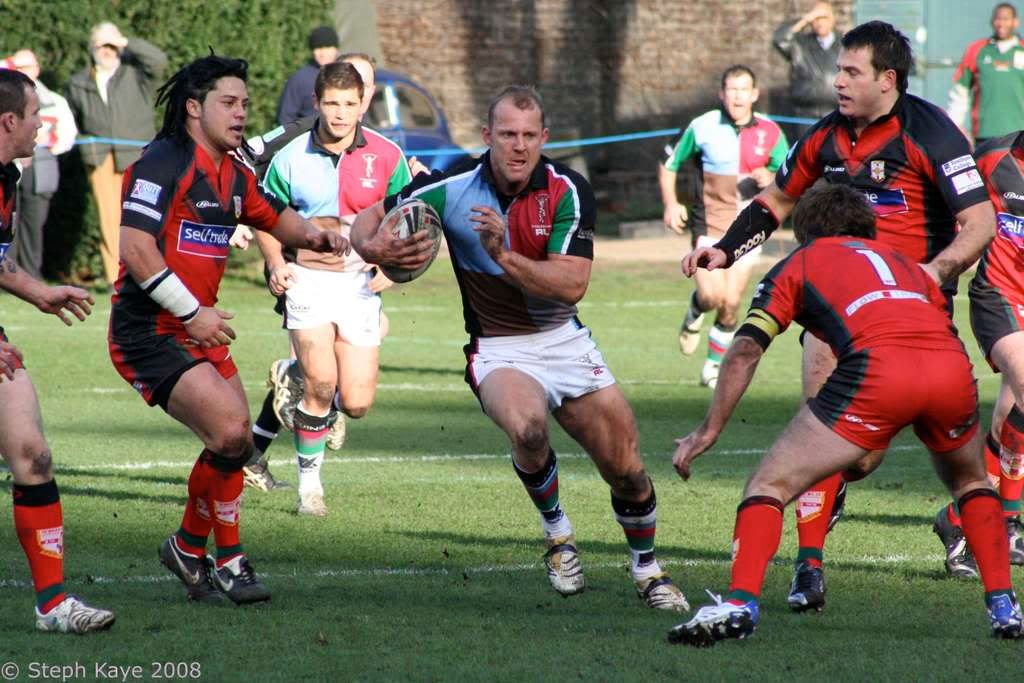


In the troublesome centre slot David Howell made an assured debut, with Matt Gafa now looking likely to fill the other centre position come the start of the season. However, youngster Tony Clubb reminded everyone of why he is knocking on the door of the first choice side with some powerful running. On the wings it looks likely that Rikki Sheriffe and Jon Wells will remain as first choices, but Will Sharp and Lamont Bryan (who interchanged with McLinden at fullback) are likely to keep them on their toes.

In the forwards Louie McCarthy-Scarsbrook shifted from prop to second row, a not entirely unforeseen move give McDermott’s previous statements about better utilising the young forwards devastating burst of speed. New signing Danny Ward slogged away at prop, in a low key but solid performance. Joe Walsh also showed he is fully recovered from his injury problems with some barnstorming runs, and it looks only a matter of time before he forces his way into the reckoning.

With captain Rob Purdham and fellow regulars Karl Temata and Daniel Heckenberg missing, and new signing Gareth Haggerty still returning from injury it’s difficult to judge how the pack will line-up come the start of the season. However, a reasonable guess is that with all props fully fit Heckenberg will start alongside either Ward or Temata, with the one who misses out joining Haggerty on the bench. McCarthy-Scarsbrook is likely to start in the second-row, with Henry Paul and Rob Purdham completing the back three of the srum. No changes are anticipated at hooker, Chad Randall provides crisp distribution and reliable defence, whilst Julien Rinaldi offers extra attacking options coming off the interchange bench. The likes of Grayshon, Walsh, Joe Mbu and new boy Dwayne Barker are all likely to feature from the bench at some point.

Quins RL CEO Paul Brown has confirmed that the club is no longer in talks with the former Newcastle Knights utility Daniel Abraham. Although the number 12 jersey had been left open for Abraham he was unable to secure a work permit, having lost his first grade slot due to injury he was subsequently played in the reserve grade side on his return to fitness, scuppering any chance that he would meet the percentage of first grade games played needed.

The one key question yet to be answered is where Chris Melling is likely to feature on his return from a groin injury. Melling was one of the standout performers last season, shining at fullback in the absence of Mark McLinden, however he’s unlikely to displace McLinden and looked unconvincing when shifted to the centres. However such selection headaches are the kind McDermott would prefer to have, rather than selections forced by injury as was the case for sections of last term.

From the London Skolars point of view the game will have been a positive experience, despite failing to score the side did produce some good attacking rugby and remained competitive for the full eighty minutes despite the class gulf between themselves and their fulltime opponents. In particular Skolars looked strong down the right hand flank, whilst the technical execution of a number of set piece plays, including one particular scrum play which should have resulted in a try for Dene Miller, were very sharp. Given that the men from North London were unable to field as strong a squad as they would have liked they showed that they now have a strength and depth that was missing a couple of seasons ago. They will start this season’s National Rail Cup competition against Doncaster next week with a genuine hope that they can make an impact.


* Photo reproduced by kind permission of Steph Kaye

Wednesday, 16 January 2008

The Times plan Rugby League blog

The Times rugby league correspondent Christopher Irvine has announced plans to the RLFANS network that the newspaper intends to launch a blog dedicated to the sport. Irvine hopes that a positive response towards the blog will put pressure on The Times to give over greater space to the sport in the print version. Slated for launch towards the end of the January, the blog is initially planned to run through to the end of the 2008 Rugby League World Cup in late November, but a successful run might see it become a permanent feature.

Although blogging as a concept originated outside of the mainstream media, traditional media companies have in recent years recognised the opportunities presented by the medium, with professional journalists using blogs as a more informal way of distributing their work. With the rise of online media constantly eroding the market for traditional print media the development of online offerings, including popular features such as blogs, is no longer a matter of differentiation but one of necessity. The development of online media opens up the possibility of online advertising revenue streams, with the online advertising market being one of the strongest growing sectors of the advertising industry.

Rugby League has often struggled to attract the attention of the mass media, especially the quality end of the market, lacking the mass support of football whilst carrying the perception of a narrower geographic distribution and lower socio-economic supporter base than comparable sports such as tennis and rugby union. Where a rugby league blog holds potential for The Times is its capacity to extend the audience for the content it produces beyond the traditional readership of the print version, many rugby league fans may not have any interest in purchasing The Times newspaper, but that won’t stop them reading the blog.

If the online rugby league audience can show a viable demand for a rugby league blog, it will not only strengthen the case for more coverage in print, but it may also force competitors of The Times to evaluate the potential of their own rugby league coverage. This would ultimately have the double benefit of raising the exposure of the game to a general audience, but in particular raising awareness of the game amongst the corporate readership of the quality press (and online versions) increasing the marketable value of the support. A win for the media companies, a win for rugby league fans hungry for quality journalism, and a win for the administrators of the sport itself.

Tuesday, 11 December 2007

Harlequins RL reach out to the public

Quins RL are planning to hold a fans forum down at The Stoop on Wednesday 19th December. The event is being billed as a means for the club to get closer to its fans and supports a number of other initiatives launched recently aimed at raising the profile of rugby league in London.

In recent years the management of Quins RL have been criticised by some sections of the supporter base for distancing themselves from the fans, although much of this criticism is perhaps drawn from the club’s previous incarnation as London Broncos whose often hand to mouth existence required greater involvement from volunteers. Some have lamented a loss of community club spirit whilst others have seen the shift as a positive development placing the administration of the club on a more professional footing.

Other efforts intended to raise the club’s profile include the open day this coming Sunday and various promotions building awareness amongst local communities. Whilst at a London wide level Hector McNeil, chairman of London Skolars, is leading efforts to sell rugby league as a whole to the business community through initiatives such as the City of London RL Luncheon Club and the revamped London Club Challenge.

The marketing of rugby league in the capital is a hard sell, nowhere else in the UK has the same level of competition for leisure spend, whilst the sports entertainment market in particular is dominated by football. It is a mark of how competitive the market is that Quins RU is the only top flight rugby union team still based in Greater London, despite the supposed strength of the code in the area.

New Quins RL CEO Paul Brown is noted for the development work done establishing community links in his time at the helm of South London Storm and as a consultant for the RFL, he will need all of that experience to grow the Quins RL brand.

Monday, 10 December 2007

2008 London Club Challenge gamble

The organisers of the traditional pre-season trial game between London Skolars and Harlequins RL are reported to be switching the game away from its traditional late January weekend slot at New River to a corporate focused event played on the afternoon of Tuesday 22nd January at the Honourable Artillery Company ground near Moorgate.

Initial indications are that tickets for the match will be restricted to three hundred people at £55 per person including some form of corporate hospitality. The hope behind the move is that it will introduce potential corporate supporters to both clubs, which in turn will produce a much needed influx of capital into rugby league in London. The danger, however, is that the game may fail to sell, leaving the clubs out of pocket and existing supporters alienated by the exclusivity of the pricing policy.

It will be interesting to see the makeup of any potential Quins side; recent years have seen a line up based largely around academy and fringe first team players allowing a more competitive friendly than would be expected from a straight clash between a professional Super League club and a semi-professional National League Two outfit. Creating any new corporate event is likely to be a challenge, creating one around a match that has traditionally been little more than a training exercise is likely to be even harder.

As by far the smaller of the two clubs London Skolars arguably have the most to lose from the event failing, a home game against Super League opposition early in the year usually attracts a decent crowd by regular season standards and with it a much needed cash boost. An expensive corporate event would need to deliver sufficient ticket sales to cover costs as once tickets have gone on sale any cancellation would leave both clubs looking very shoddy to the investors they are desperate to attract. If however just one significant investor were to come forward from the event then any short-term loss would be mitigated by the long-term benefit.

Sunday, 9 December 2007

Harlequins RL ease recruitment worries

The club moved to ease concerns over the lack of depth in the back division by signing Canberra Raiders player David Howell. Powerfully built, twenty-four year old Howell can cover the wing and fullback positions, but is most likely to fill the centre slot vacated by the departed Paul Sykes. His arrival will also hopefully provide the club with breathing space to nurture home grown youngster Tony Clubb as a long-term first team centre.

Howell joins the club amongst mixed signals over his commitment and desire to play in the UK. He is understood to be disappointed not to feature in Canberra’s plans and hopes to return to the NRL after his spell in London. Quins fans are unlikely be too perturbed about such a prospect as any return to the NRL would require Howell to demonstrate some fine form over the next two seasons.

The former St George-Illawarra junior found limited opportunities at the Dragons where he was behind Kangaroo centres Mark Gasnier and Matt Cooper seeing him switch to the Raiders in 2005. He played forty-eight first grade games during his time in the Australian capital, but after two seasons as a first choice player his appearances were restricted by injuries in 2007. He comes to Quins with a reputation as a solid performer who is prone to unfortunate errors under pressure. However Quins fans will give him the benefit of the doubt given the club’s past reputation for picking up unheralded signings who prove themselves to be inspired choices.

In other news London Skolars head coach Latham Tawhai will be making the trip across the capital to join Brian McDermott’s backroom staff as an assistant coach. Kiwi Tawhai, a former journeyman in the lower leagues, led the Skolars to their best ever standing last season and will link up with Bill Peden and Rob Powell to form one of the brightest young coaching teams in the Super League. He will be replaced at New River by former Leigh boss and fellow New Zealander Tony Benson.

Monday, 27 August 2007

Saints make it two in a row

There was to be no fairytale ending to Saturday’s Challenge Cup Final as St Helens finally overcame the plucky underdogs from Perpignan to claim back to back victories in the competition. However, there was much to be positive about as the game returned to its spiritual home, even if there is still much room to improve the experience.

For half an hour the game was a tight affair, the Catalans can consider themselves a little unlucky to see Jason Crocker’s touchdown chalked off by the video referee in what was an extremely tight call, but there was no doubt about the brilliance of James Roby’s opening try as the young hooker weaved his way through a mesmerised Dragons defence. To their credit the Catalans hit back almost immediately through Younes Khattabi and they could do little about the missed forward pass that gifted Saints winger Ade Gardner a try just before halftime and his team a slightly undeserved 12 – 4 lead going into the break.

In the second-half the power of the Saints pack and the speed of the backline took its toll on a Dragons outfit who started to wilt in the wide open spaces of the Wembley pitch. Saints fullback Paul Wellens put daylight between the two sides just after the break with an opportunist try capitalising on an error from opposite number Clint Greenshields. Youngster Paul Clough effectively ended the match as a contest ten minutes later, capping a strong run with a try.

To their credit the Catalans never gave up hope and when winger Justin Murphy pounced on an uncharacteristic error from Wellens to race away for a classic poachers try it was just reward for their efforts. Any fears of a collapse failed to materialise, although a second try from Gardner underlined the dominance of a St Helens side that ultimately never looked like losing the game.

The decision to jointly award the Lance Todd Trophy for the man of the match jointly to Paul Wellens and Leon Pryce, the first time such an award has been made, raised mant eyebrows. Whilst Wellens had a fine game, it was Saints standoff Pryce who had the single biggest impact on the proceedings, with a highly influential display in attack.

The new Wembley itself provided a magnificent venue for the eighty-four thousand plus crowd (it was noticeable that the empty seats were mainly confined to the Club Wembley areas), although the current absence of entertainment facilities in the area around the stadium compares it unfavourably with last year’s venue in Cardiff. It is to be hoped that planned redevelopment work will provide the surrounding environs will a more fitting location for the carnival atmosphere of the Challenge Cup.

Catalans Dragons: (4) 8
Tries: Khattabi, Murphy

St Helens: (12) 30
Tries: Roby, Gardner 2, Wellens, Clough
Goals: Long 5

Wednesday, 1 August 2007

Speculation mounts over Lenagan bid for Wigan Warriors

Reports that Wigan RLFC major shareholder Dave Whelan is considering offloading his stake in the club has led to speculation that a consortium led by current Harlequins RL Chairman and majority shareholder Ian Lenagan is one of two contenders vying to gain control of the Super League club.

Whelan, who also controls Wigan Athletic Football Club and the JJB Stadium which both clubs share, is understood to be interested in selling following a series of events that have seen the club punished for breaching the Super League salary cap two years in succession, the team underachieve on the pitch and the decision of Chairman Maurice Lindsay to retire at the end of the season having increasingly become the target of criticism from fans.

Lenagan, a successful businessman and theatre entrepreneur born and raised in Wigan, has yet to confirm or deny any interest, but is reported as retaining both close links to his hometown and a lifelong support for the Wigan club

Should Lenagan acquire control of the Wigan club it would undoubtedly cast doubts on the long-term future of Harlequins RL, the London based club he took control of in 2005. It was Lenagan who was the driving force behind the London club’s partnership with the Harlequins rugby union club which saw the rugby league club relocate to The Twickenham Stoop and re-brand from their previous incarnation as London Broncos.

Many fans of Harlequins RL understandably appear to be concerned at this development, although it’s far from clear whether Lenagan would be forced to offload his stake in their club following the acquisition of any stake in Wigan RLFC. Without Lenegan Harlequins RL may be forced to look for new investors, or alternatively look towards their partners Harlequins RU for support.

The other candidate for Whelan’s stake in the club is understood to be Chorley born millionaire Trevor Hemmings, the owner of Littlewoods Pools and Blackpool Tower, who already has several sporting interests including the majority shareholding of Championship football club Preston North End.

Wednesday, 11 July 2007

Good news from Quins

Harlequins RL yesterday announced a year on year uplift in ticket sales for the season to date, and with further high profile home fixtures remaining it is hoped this will continue.

The news comes as a welcome relief for many Quins fans on the back of long standing sniping criticism from the fans of many M62 corridor clubs about the level of support for London based clubs. Rugby league is a sport infamous for the parochial agenda of some fans who resent the expansion of the game beyond its traditional “heartlands” in the northern counties of England, despite the financial reality that modern professional sports need to be progressive in their outlook if they are to remain healthy. It was Sky Sports, the sport’s major paymaster, who facilitated the elevation of London Broncos to the inaugural Super League competition realising that a club in the British capital was crucial to establishing a higher profile for their investment and whilst all the clubs were happy to take the money on offer not all fans were happy with progress.

The status of Quins RL and its earlier incarnations as British rugby league’s most significant expansion club has attracted criticism of special treatment from the game’s administration, sometimes credible and sometimes based more on mythology than any substance (particularly in the case of the London Broncos holding company which was forced into liquidation by the Inland Revenue in 2005). Whilst it is true that Quins have been given special exemption from the player quota for several years, the quota has increasingly become a paper tiger due to the loopholes allowed by EU employment law, whilst flexibility with the laws of the game has never been a feature unique to the treatment of London based clubs.

The movement of the club from base to base over the past 27 years has undoubtedly hindered the development of the club, at each stop off the club has attempted to build-up a local presence only to see it abandoned with the next move. A firm settlement as Quins RL, at a modern stadium like The Twickenham Stoop which offers much needed facilities for hospitality, with solid management from the likes of Ian Lenagan will hopefully finally allow the club to develop the strength and depth it needs to become a serious challenger to the M62 clubs.

It’s also good to see the announcement that there are now 15,000 school children covered by the Quins development programme headed up by Kurt Pittman, the flow of players coming through the development system in the last couple of years has been a major bonus for the club and has removed the reliance on overseas players. With the Super League looking to reduce the number of imports and the club itself seeing the end of any advantage the quota may have once given, the development programme offers the chance to compete on a more even basis with the M62 clubs when it comes to tapping into the young player pool. There is massive potential in the South East of England and the growing improvement in the academy system and grass roots development is beginning to attract envious glances from some in the traditional heartlands.

Whilst there is a long way to go for Quins RL to truly establish itself as a serious threat to clubs such as St Helens, Bradford and Leeds improved ticket sales and promising youth development are positive steps in the right direction
.

Wednesday, 9 May 2007

Why Millennium Magic was magic

I spent the early May bank holiday weekend in Cardiff with some friends enjoying the Rugby Football League organised Millennium Magic event; basically a whole round (six games) of the elite Super League competition held over two days (three games on each day) in the wonderful Millennium Stadium.

The background to this new event is the loss of Rugby League Challenge Cup to the reopening of Wembley Stadium, which means that not only will the economy of Cardiff miss the seventy thousand plus rugby league fans who’ve poured into the city for events in recent years (which is compounded by the loss of several high profile soccer fixtures for the same reason), but those fans will miss what has been an excellent home for a rugby league event. As a result the Cardiff Council and the Welsh Tourist Board combined to offer financial incentives to the RFL to create this event.

The logic behind this is simple, it creates a showcase event mid-season which gives fans something to look forward to and the media something to write about, the game in Wales, particularly in South Wales, has never been stronger and Bridgend based club Celtic Crusaders unofficially kicked-off the weekend with a nail biting game against Oldham at home on Friday night. For the last couple of Challenge Cup’s in Cardiff many thousands of Welsh fans took the opportunity to take in a rugby league game just as many also did on Saturday and Sunday, something that would have been inconceivable not too many years ago.

Needless to say there are critics of the concept both from within and without rugby league circles, rugby league for all its expansionist and progressive efforts (not all of which have been successful) it does contain a famously resilient strain of parochialism amongst some North of England based supporters. The parochial agenda would be far happier if rugby league in Britain went no further than the traditional heartlands of (the historic counties of) Yorkshire, Lancashire and Cumberland. Behind the traditionalist argument there lies a certain insular logic that expansion means competition and competition isn’t necessarily good for individual clubs. However, if rugby league wants to remain a vibrant sport, which it very much is despite unsubstantiated myths to the contrary, it needs to continue to grow and innovate.

It was rugby league’s parochial agenda who expressed the most virulent opposition to this event, although there were a few predictable rants from hardcore rugby union antagonists, the truth is that even in the heart of rugby union territory there were plenty of supporters from the other code enjoying the opportunity of live, top flight rugby league. It is almost a truism to acknowledge that the bulk of Welsh rugby union fans have more in common with traditional rugby league fans than they do with the bulk of English rugby union fans.

Celtic Crusaders appear to be developing as the model of successful expansion; growing out of the amateur rugby league scene in South Wales they have overridden the same sort of parochialism that divides Welsh rugby union as divides rugby league in Northern England. If they continue to develop as they have been they will be a hot favourite to join the elite Super League sometime within the next five years, an achievement that would be a remarkable testament to the creeping expansion of amateur rugby league since rugby union went professional in 1995.

Of course it’s easy to get carried away by Millennium Magic, there are still plenty of tweaks that can be implemented to make it a better experience, but as a new event it’s done well; the RFL was looking for fifty thousand ticket sales over two days and it actually achieved fifty eight thousand, although the figure has sparked a rather bizarre and comedic response from the parochial agenda who have suggested that visitors who bought a ticket for the Saturday games and a ticket for the Sunday games should not have their Sunday tickets counted in the aggregate ticket sales for both days. The national media’s response to the event has also been positive and once we factor in the reality that rugby league does tend to take a while to warm to new events then the future for Millennium Magic is bright, and I for one definitely intend to make a return trip.

Friday, 16 March 2007

Skolars switch Challenge Cup clash to Belle Vue

London Skolars have taken the decision to switch their fourth round home tie with Super League side Wakefield Trinity Wildcats to the Bell Vue stadium in Wakefield. The decision to change the venue of the match scheduled for Sunday 1st Arpil, comes after talks with both the RFL and Haringey Council owners of the club’s New River home.

The New River stadium only has a safety certificate for around 1,000 seated fans in the main stand which is considered inadequate for a Challenge Cup fixture of this scale. It is estimated that it would require in the region of £20,000 to be spent bringing the ground up to the safety standard required to expand the capacity for what is in effect a one-off game.

The decision has attracted some criticism from London rugby league fans about the club spurning the opportunity to build on what would be a high profile tie in return for the financial benefit of switching to Wakefield. The critics have suggested that the club should have made more effort to find another local venue, but such criticism ignores the ignores the obvious reality that finding an alternate London venue would be costly and a small club like Skolars has to make decisions which balance development ambitions with long-term operating needs.

A fourth round tie with a Super League club will bring a club like Skolars a much needed cash injection which can be used not only to finance the first team’s forthcoming National League Two campaign, but also to continue the excellent grass roots work which the club facilitates in North London. The club is looking to turn the game into a community event involving their junior teams and also the student rugby league community out of which the club emerged.

Wednesday, 7 February 2007

RFL explores import reduction

The recent announcement from the RFL that Super League clubs are looking at ways of reducing the number of foreign imports in the game cast the spotlight on what is often a controversial and complicated topic.

The high number of overseas players is the most frequently cited reason for the standard and intensity of the Super League and lower grade competitions falling below that of the NRL and its comparative lower grade competitions. This consequently reflects in the long-term failure of British teams to compete effectively with Australia and New Zealand on the international stage. The logic is that players who weren’t considered good enough for the NRL and related competitions, come to the UK and block the career progression of young, UK developed players, which eventually feeds through to senior player pool available for selection by British representative teams.

There is undoubtedly truth in this, but a closer analysis would probably suggest player development, competitive player numbers and most importantly commercial factors all playing a significant part too.

The commercial factors stack-up like this:
- Importing a player, even one of limited ability, is cheaper in the short-term than developing a player from scratch.
- Imports can be brought in with more competitive experience than an untested home-grown junior player, which is important not only for clubs trying to avoid relegation, but also clubs pushing for honours.
- Imports will often play for relatively less than a home-grown player due to tax loopholes and favourable exchange rates.

For clubs like those in London and other “expansion” areas the problems can be particularly acute. It is only in the last ten years that the RFL has really come to value development efforts in expansion areas, which means that the volume and quality of players available locally is only now beginning to catch-up with heartland areas. The higher cost of living in the South East of England acts as a disincentive for professional players based in those traditional heartlands as in no little part does parochialism. Perversely this means that it can be easier and cheaper to pick up a decent, but unspectacular, player from the other side of the world than it is to get one to relocate 200 miles.

The move to franchises and end to automatic promotion and relegation to Super League has been seen by some as the panacea that will reduce reliance on imports, but such speculation may be hasty. Whilst the end of automatic relegation will ease the reluctance of clubs to use untested or inexperienced players, it won’t remove the desire to challenge for honours nor the other commercial factors outlined above.

As laudable as the idea of cutting down on imports may be there are some very real legal hurdles that suggest it to be little more than hot air. European Employment law designed to prevent discriminatory practices and facilitate the free movement of labour have essentially rendered the existing import quota effectively meaningless and any attempt to strengthen that existing agreement, or create a new one, will be extremely difficult. Some have argued that the law needs to be challenged, but it is unlikely that any European sports body currently has the financial muscle to attempt this, let alone the RFL or any of its constituents.

The consensus seems to be that if imports are really to be cut there will have to be some creative thinking on the part of the RFL and the clubs to find ways forward that reward player development, whilst avoiding a collision course with the law.